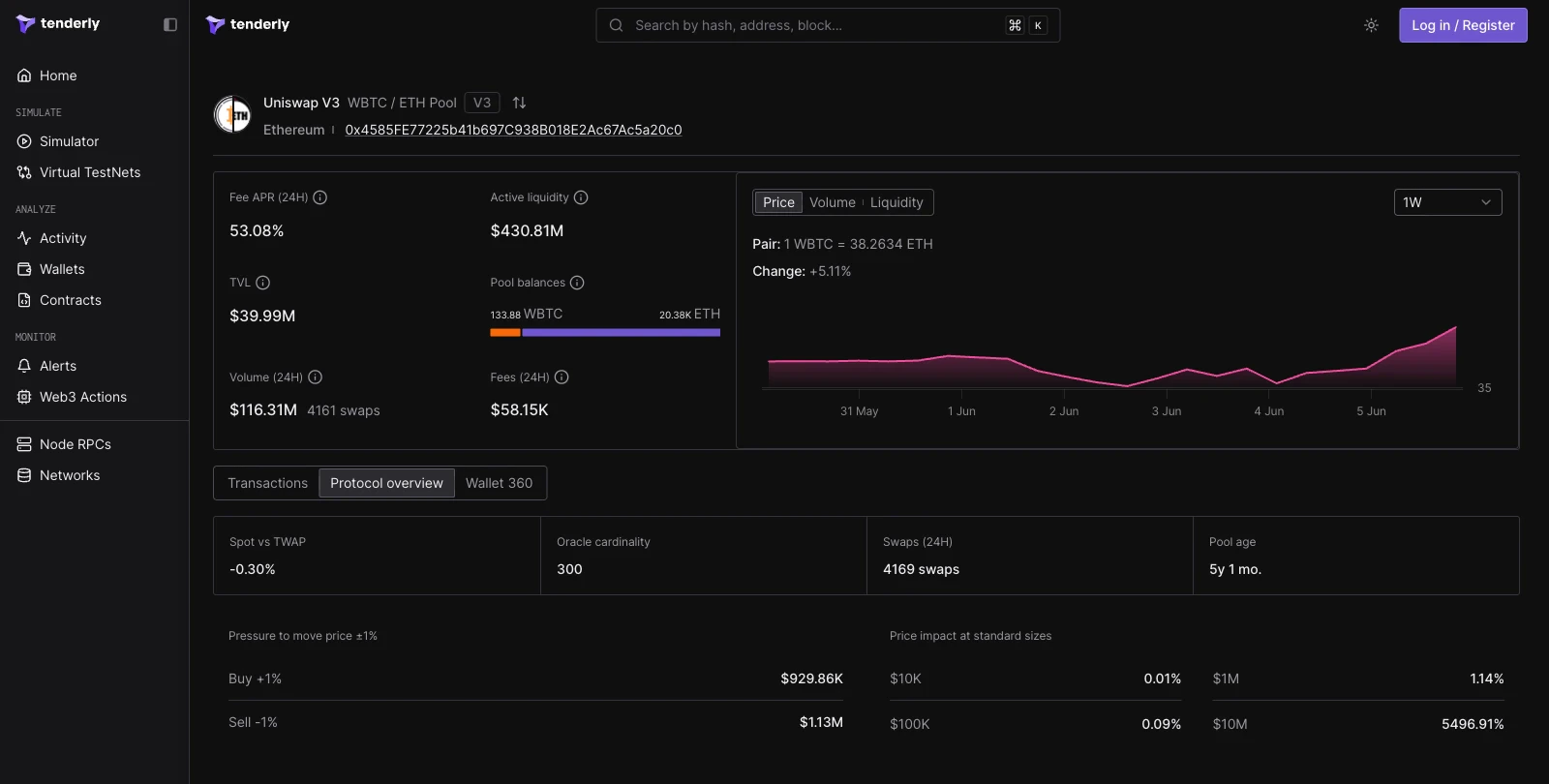
Open a live Uniswap pool in Tenderly Console
Pool header
The header identifies the contract as a Uniswap V3 pool and shows the token pair (for example, WBTC / ETH), the protocol version tag, the network, and the pool address. A toggle next to the pair name inverts the token pair display, which flips the quote direction of the price chart and pair rate. The header presents the following pool metrics:
Next to the metrics, a chart plots the pool over time with three views: Price (the pair exchange rate, with the current rate and percentage change), Volume, and Liquidity. A time range selector adjusts the window from one day up to all time.
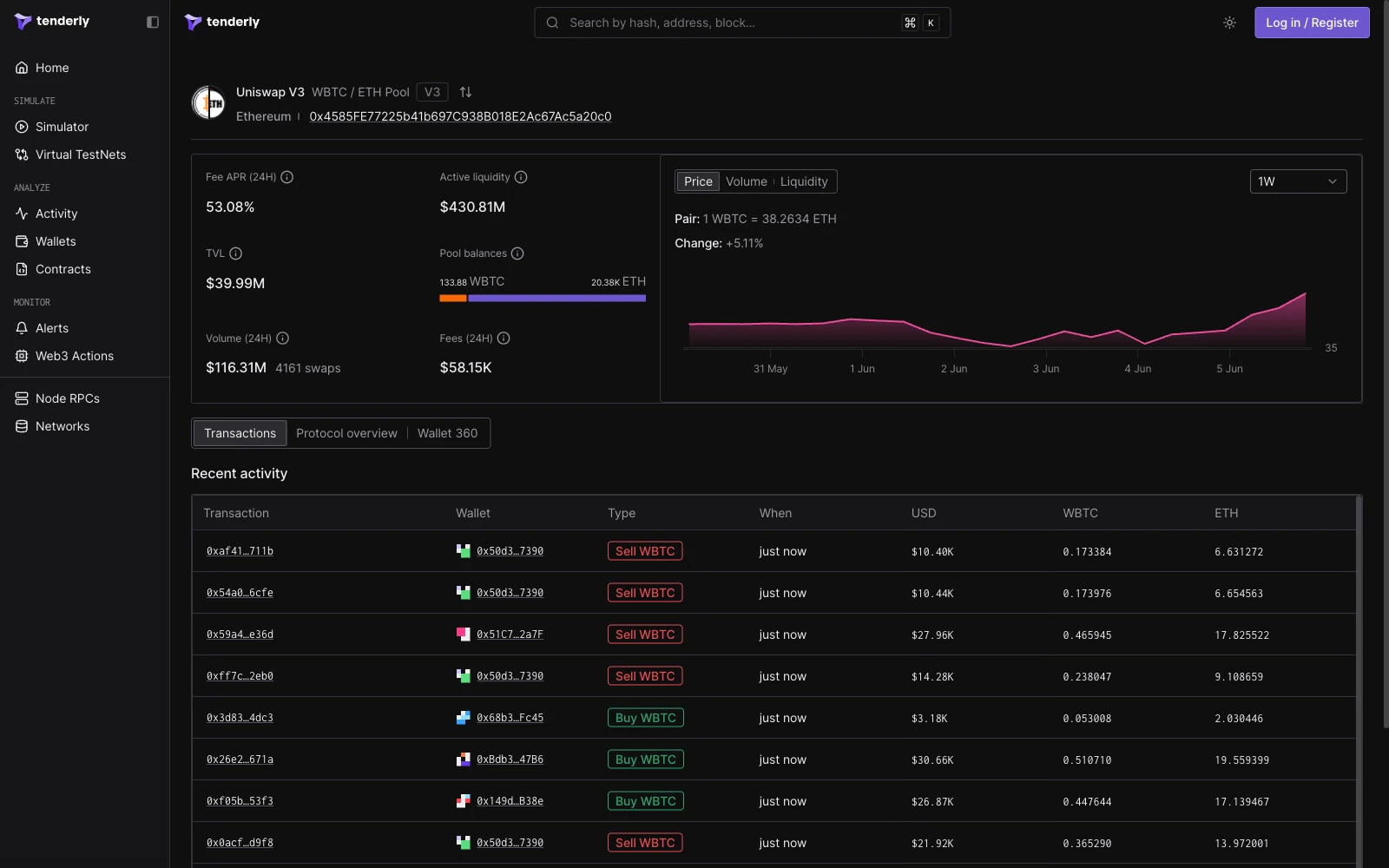
Transactions
The Transactions tab lists recent pool activity. Each swap is classified with a directional label, Buy or Sell, expressed against the base token (for example, Buy WBTC or Sell WBTC), instead of a rawswap call signature.
The table shows the transaction hash, the wallet that initiated the swap, the classification label, the time, the USD value, and the amount of each token in the pair. Transaction hashes link to the transaction detail page, and wallet addresses link to the wallet page.
Protocol overview
The Protocol overview tab presents pool quality and market depth metrics:
Two market depth panels quantify how the pool absorbs trades:
- Pressure to move price ±1%: the dollar value of buying or selling required to move the pool price up or down by one percent.
- Price impact at standard sizes: the percentage price impact of trades at $10K, $100K, $1M, and $10M.